 FR
FR Back to the website

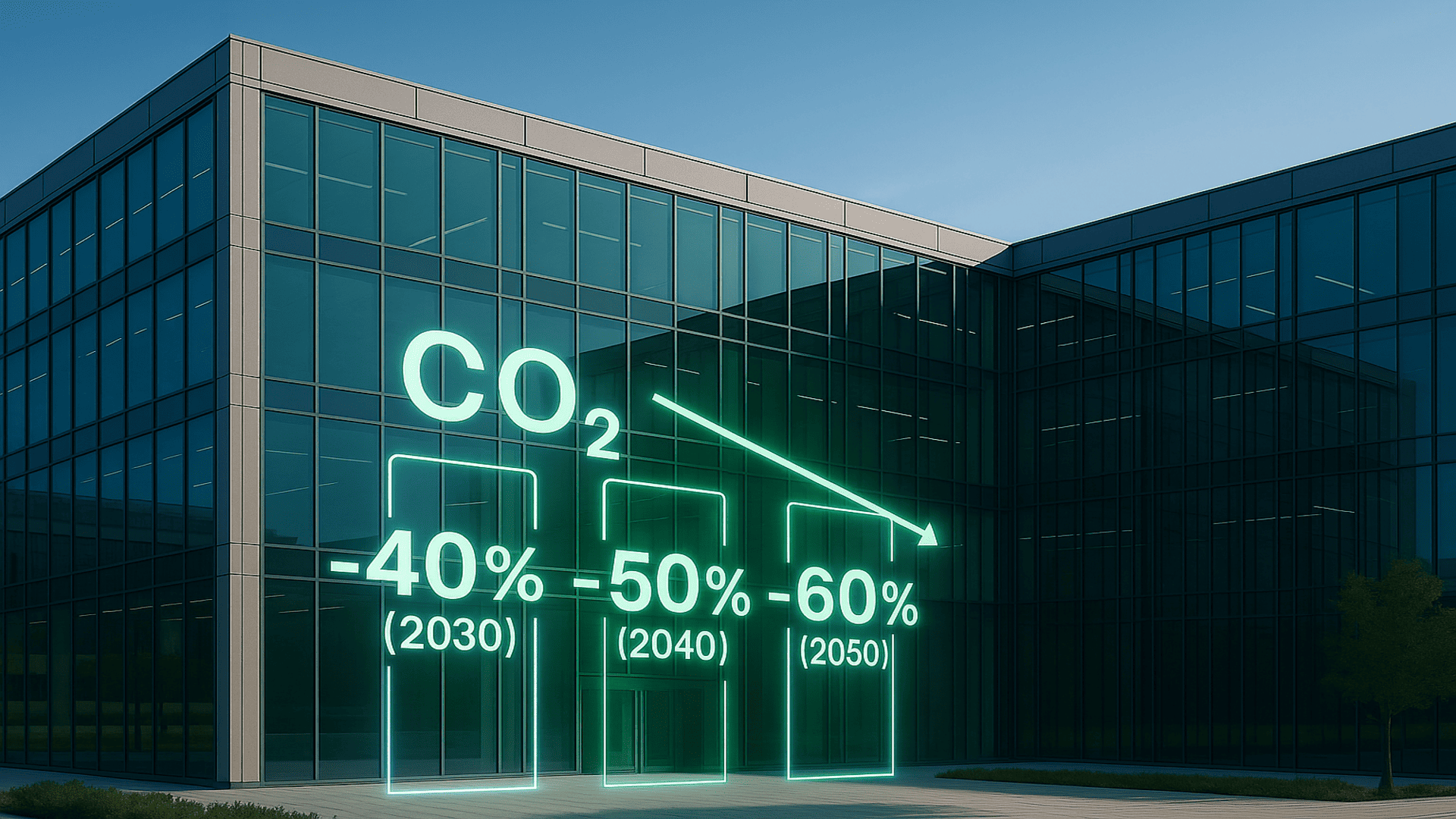
The tertiary sector accounts for a major share of energy consumption in France and contributes significantly to greenhouse gas emissions. To reverse this trend, the Tertiary Decree requires buildings larger than 1,000 m² to gradually reduce their final energy consumption: by 40% by 2030, 50% by 2040 and 60% by 2050. More than just an administrative requirement, this is a sustainable transformation: each player must implement concrete actions and demonstrate their results via the ADEME's OPERAT platform.


Understanding the legal framework
Stemming from the 2018 ELAN law, the Tertiary Decree has been incorporated into the Construction and Housing Code. The 2020, 2021 and 2024 decrees specify calculation methods and "absolute values" according to sector. Unlike other obligations, it does not define the means, but imposes verifiable results.
There are two ways of achieving compliance:
- Relative targets: reduction compared with a reference year (2010-2019).
- Absolute targets: reach a threshold expressed in kWhEF/m².an, depending on the activity.
Modulations are possible in the case of technical constraints, specific activities or disproportionate costs, subject to justification in OPERAT.
Buildings concerned
The scheme applies to all buildings or parts of buildings used for tertiary purposes, where the surface area exceeds 1,000 m². This applies to both public and private players, whether owners or tenants. Places of worship, defense buildings and temporary structures are excluded. New buildings are included from their first full year of operation, which serves as the reference year.
A clear timetable
Each year, taxpayers must declare their consumption for the previous year on OPERAT, generally before September 30. OPERAT then issues a certificate of compliance for each reporting entity. A first verification will take place in 2030 (-40%), then in 2040 (-50%) and 2050 (-60%). Preparations must be made well in advance: data collection, energy audit, strategy definition and implementation of work often take 12 to 18 months.
The importance of an energy audit
A thorough energy audit is essential. It establishes a baseline, identifies waste and prioritizes actions: quick savings (adjustments, awareness-raising) and major investments (insulation, HVAC upgrades, technical renovation). The audit must include a measurement and verification plan, with reliable sub-metering and indicators, to justify the results on OPERAT. It leads to an investment plan, a timetable and a business case, key elements in convincing owners and financial management.
Technical levers
Compliance is structured along four main lines:
- Energy conservation: fine-tuned controls, adapted schedules, eco-gestures.
- Energy efficiency: insulation, LED lighting, modernization of HVAC equipment.
- Control and automation: BMS/BMS for real-time supervision, triggering alerts and automatically adjusting consumption.
- Decarbonization: use of renewable energies and decarbonized heating networks.
Interoperability and scalability of solutions are essential to manage multiple sites and facilitate reporting to OPERAT.
The key role of sensors
Without reliable data, compliance is impossible. Connected sensors enable continuous monitoring of temperature, humidity, CO₂, VOCs or occupancy rates. This information feeds the BMS, documents energy gains and simplifies annual reporting. They also contribute to indoor air quality, a growing issue for the health and comfort of occupants.
Training and follow-up
Success also depends on the technical teams, who must master the reading and interpretation of the data, and on the occupants, whose behavior directly influences performance. Regular monthly or quarterly reviews enable deviations to be quickly corrected, and measurement and control equipment to be maintained on a preventive basis.
Sanctions and opportunities
Non-compliance can result in formal notices, publication of the breach ("name & shame") and fines of up to €7,500 for legal entities. But the real stakes are the reputation and value of real estate assets. A non-compliant building loses its appeal.
Conversely, the Tertiary Decree is a sustainable opportunity to reduce costs, improve comfort, enhance the value of assets and contribute to climate objectives. Anticipation, reliable data and investment in high-performance solutions can transform regulatory constraints into a competitive advantage.
.svg)
