 FR
FR Back to the website

In apartment buildings, offices, schools, hotels, and healthcare facilities, heating is a critical system that must be precisely controlled. A LoRaWAN-connected thermostatic head allows for direct control of each hot-water radiator while maintaining centralized monitoring of the entire system. For professionals, distributors, and integrators, Nexelec’s FLOW PRO and FLOW CORE solutions address a clear need: local control, remote monitoring, and simplified on-site maintenance.


Why choose a LoRaWAN thermostatic head for a commercial building?
A conventional thermostatic head mechanically controls the radiator valve to adjust the hot water flow based on the room temperature. A LoRaWAN thermostatic head goes a step further: it combines heating control, long-range radio communication, setpoint programming, and data transmission to a monitoring platform.
In a commercial building, this approach allows for room-by-room heating control without relying on a constant command sent from the cloud. Setpoints can be stored locally within the device, while the LoRaWAN network is used to transmit status updates, alerts, settings, battery information, and software updates.
For an integrator or facility operator, the benefits are twofold. On the one hand, the installation remains compatible with renovation projects, particularly when retrofitting existing hydronic radiators. On the other hand, control becomes more precise than a single centralized system, which is often insufficient to account for the actual usage patterns in each room.
FLOW PRO and FLOW CORE: Two Thermostatic Heads Designed for Real-World Applications
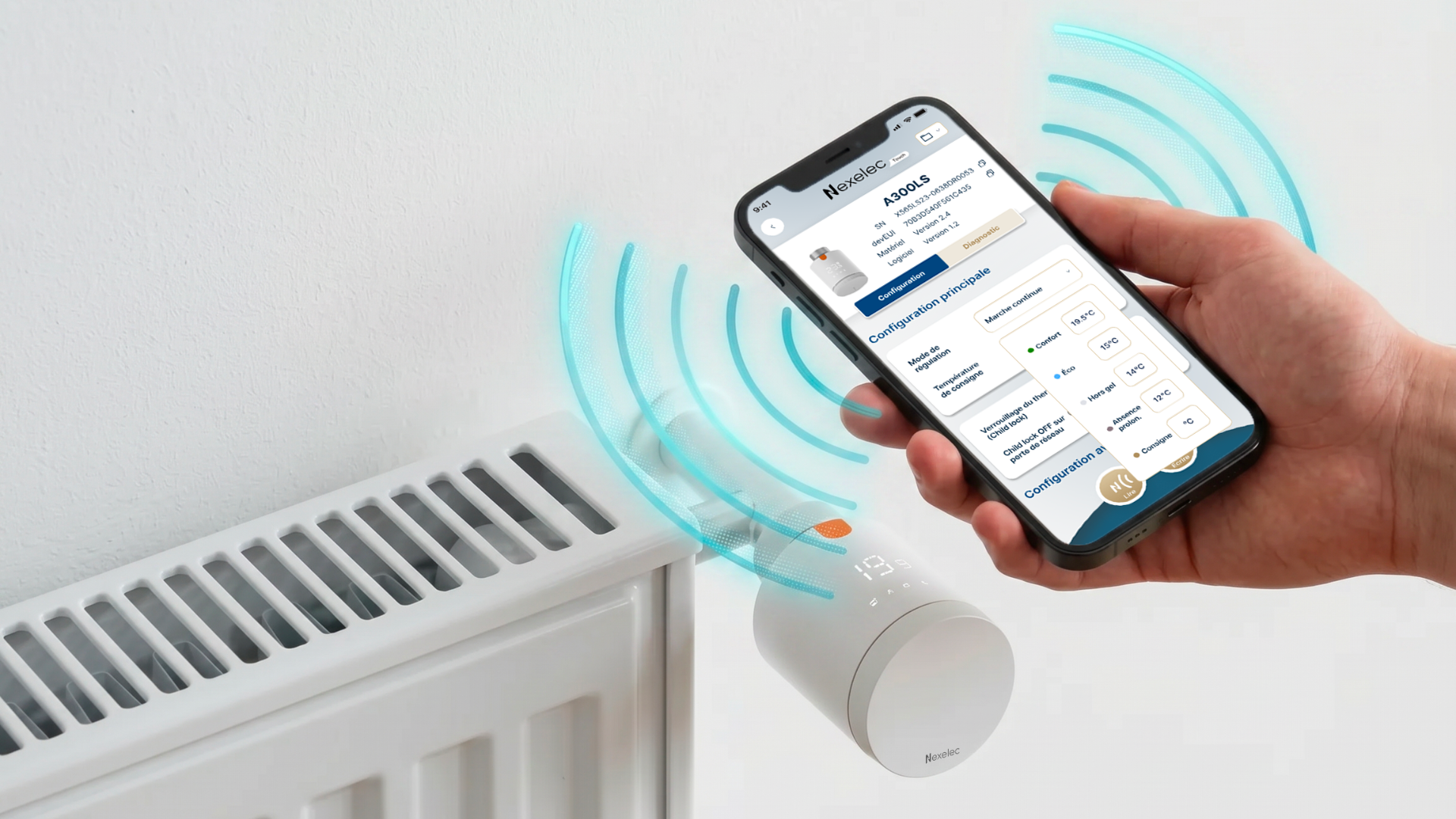
Nexelec offers two complementary models: FLOW PRO and FLOW CORE. These two connected thermostatic heads are designed for hot-water radiators and feature LoRaWAN connectivity, NFC configuration via smartphone, and built-in smart control.
FLOW CORE is positioned as a compact, high-performance thermostatic head suitable for energy-efficient renovation projects, multi-unit residential buildings, hotels, offices, and commercial buildings. It runs on two replaceable AA lithium batteries, with a standard battery life of 6 years and up to 10 years depending on usage.
FLOW PRO is designed for more demanding environments, particularly high-traffic multi-unit buildings such as schools, hospitals, apartment complexes, or public facilities. Its RUG mounting base, reinforced with metal inserts, improves mechanical strength. It runs on four replaceable lithium batteries and can last up to 12 years depending on usage conditions.
Intelligent control tailored to the room
The performance of a thermostatic head does not depend solely on its ability to open or close a valve. It relies primarily on the quality of temperature measurement, the stability of the setpoint, and the ability to adapt heating to the building’s usage patterns.
FLOW PRO and FLOW CORE feature a high-precision temperature sensor and allow temperature adjustment in 0.5 °C increments. This setpoint precision helps maintain a more stable temperature, prevent overheating, and improve occupant comfort.
For configurations where the temperature measured near the radiator may be skewed by a curtain, sunlight, drafts, or convection, Nexelec offers the NODE remote sensor. Placed within the room, it measures a temperature that more accurately reflects actual comfort levels. Using the Nexelec L2D1 radio protocol, NODE communicates directly with FLOW, without requiring a LoRaWAN gateway or relying on the main network.
This remote measurement is particularly valuable for system integrators who need to ensure reliable temperature control in hotel rooms, classrooms, offices, residential units, or medical care rooms.

Simplified Installation
In a deployment project, the product’s technical quality alone is not enough. Installation time, compatibility with existing valves, and ease of commissioning are critical to the project’s profitability.
FLOW PRO and FLOW CORE can be configured via NFC using a smartphone. This NFC configuration allows parameters to be quickly set up on-site without complex procedures. Schedules, setpoints, and control modes can then be adjusted remotely via LoRaWAN based on the building’s layout.
Compatibility with existing radiators is facilitated by ADAPT adapters. This set of adapters allows FLOW thermostatic heads to be installed on most thermostatic valves on the market, including certain Danfoss, Cale, Giacomini, and M28 standards. For an integrator, this reduces unforeseen issues, minimizes the need to replace valve bodies, and speeds up deployments in renovation projects.
The integrated color tabs also make it easier to visually identify equipment on-site. This is an important detail during installation, maintenance, or the management of a large fleet of radiators.
Remote Monitoring with LoRaWAN and NAVIXIS
A LoRaWAN thermostatic head is most valuable when integrated into a comprehensive energy management strategy. Thanks to the LoRaWAN wireless network, operators can monitor equipment status, program temperatures, adjust schedules, and receive alerts remotely.
With the NAVIXIS platform, Nexelec enables centralized monitoring of the system. Professionals can manage temperatures, monitor radiator banks, check operation, configure alerts, and schedule maintenance without the need for routine on-site visits.
This approach is particularly well-suited for multi-zone or multi-site buildings. A facility manager can adjust the Comfort, Eco, Away, or Frost Protection modes based on occupancy schedules, holidays, vacation periods, or the specific needs of each space.
Local control remains autonomous, however. Even in the event of a temporary loss of LoRaWAN connectivity, the schedules stored in the thermostat head continue to control the heating. The network is therefore used to monitor, update, and optimize, without becoming a permanent dependency for control.
Maintenance, Autonomy, and Operational Continuity
For a distributor or integrator, the retail price of a connected thermostatic head should not be considered in isolation. The true criterion is the total cost of ownership: battery life, ease of maintenance, durability, tamper protection, software updates, and reduced on-site visits.
FLOW CORE operates on 2 replaceable AA lithium batteries. FLOW PRO uses 4 replaceable lithium batteries to achieve longer battery life in the most demanding environments. In both cases, the use of standard batteries simplifies service planning and eliminates the need to rely on an energy-harvesting system that is more sensitive to actual heating conditions.
Both models feature an anti-seizing function. The thermostatic head automatically activates the radiator mechanism once a month to prevent the valve from seizing up outside the heating season. This feature is particularly valuable in hydronic systems, where a thermostatic valve can seize after several months of inactivity.
Window-opening detection allows heating to be temporarily suspended when a rapid drop in temperature is detected. Control locking prevents unwanted local adjustments to the set temperature. Anti-tamper detection triggers an alert if the head is removed from its base.

Safety, Cybersecurity, and Protection in Shared Environments
Commercial buildings present specific challenges: unauthorized tampering, risk of disassembly, impacts, vandalism, public access, or heavy use. FLOW PRO and FLOW CORE feature anti-theft protection with a lockable base and security screws.
FLOW PRO reinforces this protection with its RUG base featuring metal inserts, designed for the most demanding environments. For exposed locations, the CASE protective cover mechanically shields the thermostatic head from impacts and tampering attempts. It also restricts access to the manual adjustment knob.
Cybersecurity is also a key selection criterion for system integrators. Data transmitted by FLOW is secured end-to-end using dual AES128 encryption. This approach meets the requirements of professional IoT projects, where connected devices must remain reliable, secure, and maintainable over the long term.
FLOW PRO or FLOW CORE: How to Choose the Right Model?
The choice between FLOW PRO and FLOW CORE depends primarily on the usage context, the expected level of robustness, the need for remote control, and the planned maintenance strategy.
FLOW CORE is suitable for projects seeking a compact, high-performance, and easy-to-install LoRaWAN thermostatic head. It meets the needs of apartment buildings, hotels, offices, commercial spaces, or smart home projects where temperature control must remain simple to deploy and monitor.
FLOW PRO is recommended when on-site conditions are more demanding. Its reinforced base, extended battery life, and heavy-duty design make it a suitable solution for schools, hospitals, multi-unit residential buildings, public facilities, or sites where equipment is more exposed to harsh conditions. Before a large-scale deployment, testing in a pilot area can help validate valve compatibility, LoRaWAN radio quality, and control scenarios.
In both cases, the Nexelec ecosystem enables the creation of a comprehensive solution centered around the thermostatic head: NODE for more reliable ambient temperature measurement, ADAPT to facilitate installation on existing valves, CASE — the protective cover —and NAVIXIS to monitor the connected fleet. Professionals can then request a quote tailored to the number of devices, the type of site, and the necessary accessories.
.svg)
