 FR
FR Back to the website

A smart thermostatic head allows you to regulate the temperature in each room by automatically controlling the flow of hot water through the radiator. For professionals managing offices, block of flats, schools or healthcare facilities, this room-by-room control makes it easier to manage the heating and can help reduce energy consumption.
However, not all thermostatic heads can be fitted directly to all radiators. Before choosing a unit, you need to identify the type of thermostatic valve, check the valve body, measure the connection and determine whether an adapter is required.
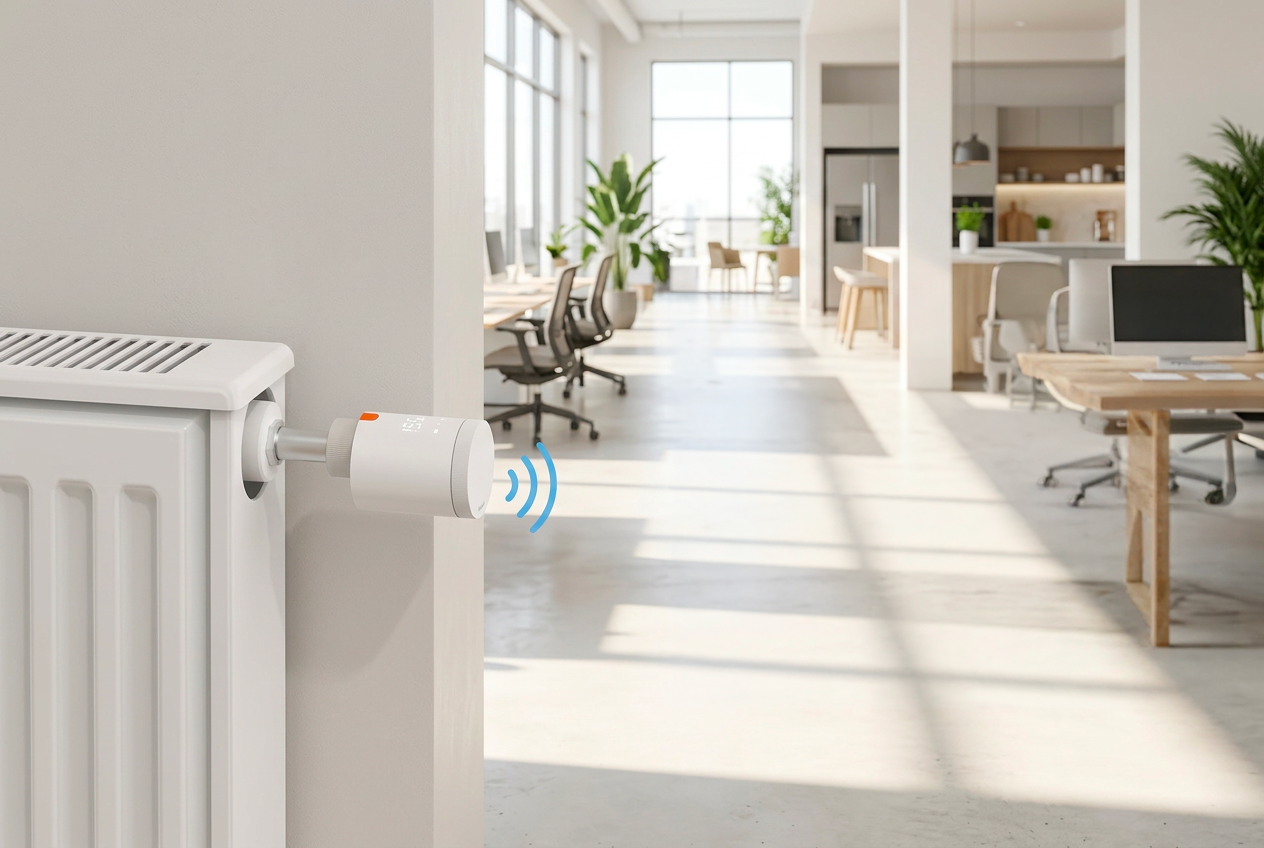


How does a smart thermostatic head work on a hot-water radiator?
A smart thermostatic head replaces the mechanical head installed on a radiator thermostatic valve. It contains a motor that acts on the valve body’s piston to adjust the flow of hot water.
When the room temperature is below the setpoint, the head allows more water to flow through the radiator. Once the desired temperature is reached, it gradually reduces the flow rate. The heat emitted by the radiator thus adapts to the room’s actual needs.
Unlike a centralized smart thermostat, which typically controls the entire heating system, smart thermostatic heads allow for local control. Each radiator can follow a specific temperature and schedule based on the area’s usage.
This setup is particularly useful in buildings with rooms that are occupied at different times. For example, it avoids maintaining the same temperature in an unoccupied meeting room, an office used all day, and a bedroom that is rarely occupied.
Is a smart thermostatic head compatible with all radiators?
Compatibility depends mainly on the valve installed, not on the radiator’s material or shape. A cast-iron, steel, or aluminum radiator can be fitted with a smart thermostatic head if it is equipped with a compatible thermostatic valve body.
The radiator must also be part of a hot-water heating system powered by a boiler, a district heating network, or a heat pump. A thermostatic head for a water-filled radiator cannot control an electric radiator, as the latter has neither a hydraulic valve nor a water flow to regulate.
You should therefore check three things:
- the type of valve on the radiator;
- the mounting system for the valve;
- the mechanical condition of the valve body.
Conducting an assessment before purchase helps prevent ordering incompatible thermostatic heads or unsuitable adapters.
Identifying a Manual Valve or a Thermostatic Valve
The first step is to determine whether the radiator has a manual valve or a thermostatic valve.
A manual valve is typically equipped with a single handle. It allows the user to open or close the water flow, but its body is not always designed to accommodate a thermostatic head. In this case, it’s generally not possible to directly replace the handle with a smart thermostatic head.
Installing a thermostatic head therefore requires replacing the valve body with a thermostatic valve body. This procedure directly affects the hot water system and may require partially draining the system. It must be performed by a heating professional.
A thermostatic valve, on the other hand, has a removable head and a small metal piston in the center of the valve body. This piston is actuated by the head to control the flow of hot water.
To check its condition, the existing head can be removed without disassembling the faucet body. The piston should be able to be pressed in slightly and return on its own to its original position. A seized, stuck, or damaged piston must be repaired before installing the connected thermostatic system.
Check the thread on the thermostatic valve body
The thread is one of the main criteria for compatibility between a smart thermostatic head and a radiator.
The M30 x 1.5 connection is one of the most common standards. The designation M30 corresponds to a nominal diameter of 30 millimeters, while 1.5 refers to the thread pitch. Many thermostatic heads are compatible with this size, but this information should always be verified in the manufacturer’s technical documentation.
Some thermostatic valve bodies do not have an M30 x 1.5 thread. This is particularly true for several Danfoss models that use RA, RAV, or RAVL mountings. These systems may use a snap-on connection, a clamping ring, or a specific diameter.
To correctly identify the fitting, the professional must remove the existing head and examine the valve from the front and side. It is important to note the brand, model number, outer diameter, whether a thread is present, and the shape of the mounting system.
Technical documentation from specialized manufacturers such as Danfoss or Caleffi can help identify the different types of thermostatic valves.
Which adapter should be used to make the thermostatic head compatible?
An adapter allows a thermostatic head to be installed on a valve body that uses a different mounting system. It provides a mechanical connection between the two components without altering the radiator’s hydraulic operation.
The choice of adapter must be based on the exact valve part number. A simple visual comparison is not sufficient, as several models may have a similar shape but use different diameters or locking systems.
An adapter may be necessary, in particular, for certain Danfoss RA, RAV, or RAVL valves. However, the standard Danfoss adapter depends on the specific model actually installed. Forcing a head onto the valve or using an incompatible adapter ring can prevent the motor from actuating the piston properly.
Nexelec’s FLOW PRO and FLOW CORE solutions can be paired with adapters designed for the main thermostatic valve bodies on the market. This approach simplifies projects involving multiple brands or generations of radiators.
In a large building portfolio, it is recommended to conduct an inventory of the valves before deployment. Teams can photograph each type of valve body, note the part numbers, and group the radiators by connection type. This preparation simplifies the installation of thermostatic heads and minimizes the need for additional work.
What technical criteria should be checked before installation?
Mechanical compatibility with the valve body is not the only factor to check. The overall operation of the heating system must also be examined.
The professional must check the type of hydraulic system, specifically whether it is a single-pipe or two-pipe system. They must also verify the circuit’s balance, pressure, water temperature, and available flow rate.
A connected thermostatic valve cannot correct a radiator clogged with scale, insufficient circulation, or poor hydraulic balancing. Even if the valve head functions correctly, the room temperature will remain difficult to regulate if the radiator does not receive the necessary water flow.
The valve’s orientation must also be taken into account. A thermostatic head placed behind a curtain, under a shelf, inside a radiator cover, or in close proximity to a heat source may measure a temperature different from what is actually felt in the room.
In this type of setup, using a remote temperature sensor provides a more accurate reading. The thermostatic head can then control the valve based on a temperature reading taken from a more exposed area.
Finally, the space around the valve must allow for battery insertion, replacement, and access to the device during maintenance operations.
How do you install a compatible smart thermostatic head?
Once the valve type and adapter have been identified, installation can be carried out without interfering with the water system if the radiator already has a thermostatic body in good condition.
The first step is to remove the old thermostatic head. Depending on the model, this step requires loosening a ring, a screw, or a clip mechanism. The valve body remains attached to the radiator.
The technician then checks the piston’s mobility, installs the adapter if necessary, and secures the smart head. The head must be tightened securely enough to hold the equipment in place without exerting excessive force on the valve.
After the batteries are installed, the head typically undergoes a calibration phase. The motor identifies the piston’s stroke and the positions required to open or close the radiator’s thermostatic valve.
Setpoint temperatures, schedules, and operating modes can then be configured. A Comfort mode can be used during periods when the room is occupied, while an Eco or Frost Protection mode reduces the temperature when the room is unoccupied.
FLOW PRO and FLOW CORE for Controlling Hot-Water Radiators
The FLOW PRO connected thermostatic head is designed for commercial projects requiring room-by-room heating control and remote monitoring. It can be used in apartment buildings, offices, hotels, schools, or healthcare facilities.
Its centralized management makes it easy to adjust temperatures, schedules, and heating scenarios across a group of radiators. It also allows building managers to minimize the need for manual intervention in each room.
The FLOW CORE thermostatic head provides a solution tailored to systems requiring local control and built-in heating schedules. It can be deployed gradually within a single building or across multiple sites.
.svg)
