 FR
FR Back to the website

The BACS 2027 decree requires managers of commercial buildings to improve their control of heating, ventilation and air-conditioning systems. Although some deadlines have been extended to 2030, achieving compliance requires planning ahead for the installation of a building management system, the collection of energy data and room-by-room heating control. Solutions such as FLOW CORE and FLOW PRO enable the modernisation of existing equipment and the integration of local control into an overall energy management strategy.


BACS 2027 Decree: What Are the Requirements for Commercial Buildings?
The BACS Decree regulates the installation of automation and control systems in commercial buildings. The term BACS stands for Building Automation and Control System. In France, it refers to systems capable of monitoring and controlling a building’s main technical equipment.
This requirement applies in particular to buildings equipped with a heating or air conditioning system—whether or not combined with a ventilation system—whose rated output exceeds certain regulatory thresholds.
For existing commercial buildings equipped with systems whose rated power exceeds 290 kW, the regulatory deadline was originally set for January 1, 2025. For systems with a capacity between 70 and 290 kW, the date originally set for January 1, 2027, was postponed to January 1, 2030, by the decree of December 26, 2025. The term “BACS 2027 Decree” therefore remains in common use, but it no longer corresponds to the current deadline for this category of buildings.
An exemption may be considered if the owner demonstrates that installing an automation and control system would not result in a return on investment within ten years. This demonstration must be based on a documented study that takes into account expected energy savings and available public financial assistance.
What is the role of a building management system (BMS) under the BACS Decree?
Building management systems (BMS) are at the heart of an installation that complies with the BACS decree. They centralize information from the building’s technical systems and adjust their operation to actual needs.
A BMS can oversee heating, ventilation, air conditioning, domestic hot water production, lighting, and certain electrical equipment. It collects data, monitors consumption, detects deviations, and facilitates corrective actions.
In particular, the automation and control system must be capable of monitoring and recording energy consumption data, analyzing equipment efficiency, identifying performance losses, and notifying the operator when improvements are possible. It must also be able to communicate with the building’s various technical systems.
BMS is therefore not limited to displaying a temperature or activating a boiler. It manages the building’s energy operations based on scenarios, schedules, setpoints, and data reported by the installed equipment.
%20under%20the%20BACS%20Decree_%20-%20visual%20selection.png?width=1030&height=626&name=What%20is%20the%20role%20of%20a%20building%20management%20system%20(BMS)%20under%20the%20BACS%20Decree_%20-%20visual%20selection.png)
The BACS Decree and the Tertiary Sector Decree: What Are the Differences?
The BACS Decree and the Tertiary Sector Decree share a common goal of energy efficiency, but they do not require the same actions.
The Tertiary Decree sets targets for reducing energy consumption in the relevant commercial buildings. The BACS Decree focuses more on the technical means for measuring, automating, and controlling equipment.
A building management system (BMS) can thus facilitate compliance with the Tertiary Decree. It gives facility managers greater visibility into energy consumption and enables them to address the main sources of energy costs, particularly HVAC systems.
Heating is a particularly important area for improvement. General control at the boiler room level is not always sufficient to prevent overheating, especially when usage patterns vary significantly from one room to another.
Why control heating room by room?
In a commercial building, not all areas are occupied at the same time. An individual office, a meeting room, a classroom, a hotel room, or a hallway each have different needs.
Applying a single setpoint to the entire building can lead to unnecessary energy consumption. Some rooms remain heated even when empty, while others receive too much heat due to their exposure, the number of occupants, or solar gain.
Room-by-room control allows the temperature to be adjusted to the actual use of each space. Regulations also stipulate that a local control system must be able to automatically adjust the heating temperature in minimum hourly increments, by room or, when justified, by heating zone.
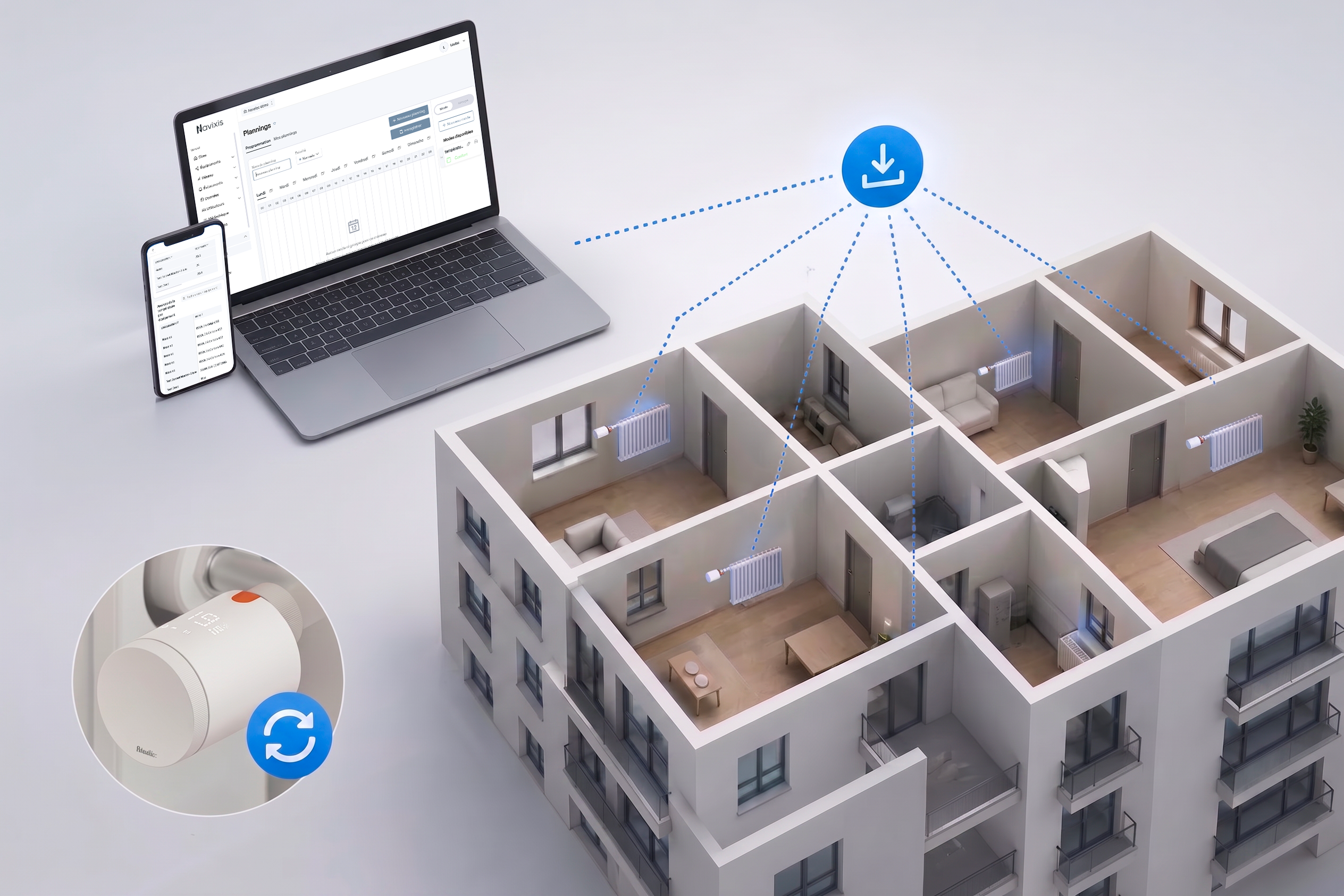
This local control complements the building management system (BMS). The BMS defines and oversees the energy strategy, while the devices installed on the radiators execute the setpoints as closely as possible to actual needs.
How do you implement room-by-room control?
Identify the building’s zones and uses
The first step is to conduct an inventory of spaces, heat emitters, and occupancy schedules. The building must be divided into coherent functional zones.
In offices, meeting rooms may require different settings than permanent workspaces. In a school, temperatures can be adjusted according to class schedules, school breaks, and periods when the building is unoccupied. In a hotel, heating can be adjusted based on room occupancy.
This zoning forms the basis of an efficient energy management system.
Install local control devices
Each hot-water radiator can be equipped with a connected thermostatic head. This device locally regulates the water flow through the radiator to achieve the desired temperature.
To be truly useful in a commercial building, the equipment must be able to store schedules, apply multiple operating modes, and continue to regulate even in the event of a temporary loss of power.
A remote sensor can also measure the temperature at a location that is more representative of the room. Measurements taken directly near the radiator can indeed be affected by convection, a curtain, a niche, or specific exposure.
Connecting the Control System to the Building Management System
Room-by-room control is most effective when integrated into a building management system. Setpoints and schedules can then be adjusted remotely, while relevant data is fed back to a monitoring platform.
The facility manager can identify malfunctioning equipment, monitor the status of heating coils, modify schedules, and avoid routine on-site visits. This automation of control facilitates the operation of existing buildings, particularly those with several hundred radiators.
FLOW CORE for Modernizing Heating in Existing Buildings
FLOW CORE is a connected thermostatic head designed to control hot-water radiators. It combines local control, NFC configuration, and LoRaWAN wireless communication.
Heating schedules are stored directly in the thermostatic head. As a result, the system continues to operate even when communication with the network or monitoring platform is temporarily unavailable.
FLOW CORE offers several modes, including Comfort, Eco, Frost Protection, and Away. Temperatures and schedules can be tailored to the building’s usage patterns and then adjusted remotely.
The device can operate with a NODE remote sensor. In this case, the temperature is measured in the actual room environment rather than at the radiator. This configuration improves control accuracy and helps maintain more consistent comfort levels.
FLOW CORE runs on two replaceable AA lithium batteries. Its standard battery life is rated at six years and can reach up to ten years depending on settings and operating conditions.
FLOW PRO for large-scale heating control
FLOW PRO is designed for multi-unit buildings and demanding commercial environments. It is particularly suitable for offices, hotels, schools, hospitals, and public facilities.
Its reinforced base with metal inserts improves resistance to tampering and heavy-duty use. FLOW PRO also features an anti-seizing function, open-window detection, manual lock, and remote software update capabilities.
Settings and schedules are stored locally. The thermostatic head directly controls the radiator without relying on continuous commands sent from the cloud. The LoRaWAN connection then allows for monitoring the entire system, modifying settings, and reporting information useful for maintenance.
FLOW PRO operates on four replaceable lithium batteries and can last up to twelve years, depending on usage conditions. This design minimizes the need for on-site service calls for installations with a large number of units.
Are FLOW CORE and FLOW PRO sufficient to comply with the BACS decree?
A connected thermostatic head is a terminal control device. On its own, it does not replace all the functions expected of a BACS system.
Compliance must be assessed at the building level. The system architecture must allow for monitoring energy consumption, analyzing performance, detecting deviations, and supervising the various technical systems involved.
FLOW CORE and FLOW PRO can nevertheless play an essential role in this architecture. They allow heating setpoints to be applied at the room level and transmit the necessary information for monitoring.
The combination of a building management system (BMS) and connected thermostatic heads thus creates a complete control chain: the BMS defines the scenarios, the platform centralizes the data, and the local equipment regulates the radiators.
What benefits can be expected from room-by-room control?
The first benefit is energy savings. By adjusting setpoints based on schedules and occupancy, the facility manager minimizes unnecessary heating periods and prevents overheating.
The second benefit relates to comfort. A more accurate temperature measurement helps prevent significant temperature variations between different areas of the building.
The third benefit relates to operations. Centralized monitoring makes it easier to track a large number of systems, detect anomalies, and schedule maintenance work.
Finally, the collected data can help the facility manager document actions taken in accordance with the Tertiary Sector Decree, assess the building’s energy performance, and prepare for inspections related to automation and control systems.
How to Prepare a Building Management System (BMS) Installation Before 2030?
Preparation begins with an audit of the building’s technical systems. It is important to identify the heating and cooling units, their rated capacity, the HVAC equipment, the existing networks, and the control solutions already installed.
The facility manager can then define a phased deployment strategy. The areas with the highest energy consumption, spaces subject to significant fluctuations in occupancy, and buildings that are easiest to retrofit can be addressed first.
The design phase must also ensure interoperability between equipment, the building management system (BMS), communication gateways, and the monitoring platform. The responsibilities of the owner, operator, integrator, and maintenance provider must be clearly defined.
This forward planning allows for testing scenarios, training teams, and measuring initial results before the regulatory deadline.
What financial assistance is available to fund a building management system installation?
Technical Standard BAT-TH-116 covers building management systems for heating, domestic hot water, cooling, air conditioning, lighting, and auxiliary systems.
It may support the installation of a new BMS or the retrofit of an existing system, provided the technical criteria of the guideline are met. In particular, the system must provide Class A or B control functions as defined by standard NF EN ISO 52120-1:2022.
Eligibility for and the amount of energy savings certificates depend on the BMS class, the managed area, the controlled uses, and the terms of the project. An analysis conducted before signing the contracts allows potential incentives to be factored into the return on investment calculation.
Implementing a Heating Strategy Tailored to Commercial Buildings
The postponement of part of the BACS 2027 decree to January 1, 2030, provides additional time for building owners and managers, but achieving compliance requires several steps: an audit, selection of the building management system architecture, zoning, equipment installation, scenario configuration, and performance monitoring.
Thanks to their local control and LoRaWAN connectivity, FLOW CORE and FLOW PRO enable room-by-room heating control while facilitating remote monitoring. Integrating them into a building management system helps operators gradually modernize their systems, limit overheating, and prepare for upcoming energy regulations.
.svg)
